

Saudi Arabia cannot afford to treat usable water as waste. Hotels, residential compounds, factories, labour camps and commercial developments all generate wastewater that can become a dependable resource when it is treated correctly.
A successful treated wastewater reuse in Saudi Arabia strategy can reduce freshwater consumption, lower wastewater disposal costs and provide water for approved nonpotable applications. The treatment system must still be designed around the intended use. Water suitable for landscape irrigation may not be suitable for cooling towers or an industrial process.
Good reuse planning starts by answering three questions. What is present in the wastewater? What quality must the treatment system achieve? Where will the recovered water be used every day?
Where Can Treated Wastewater Be Reused?
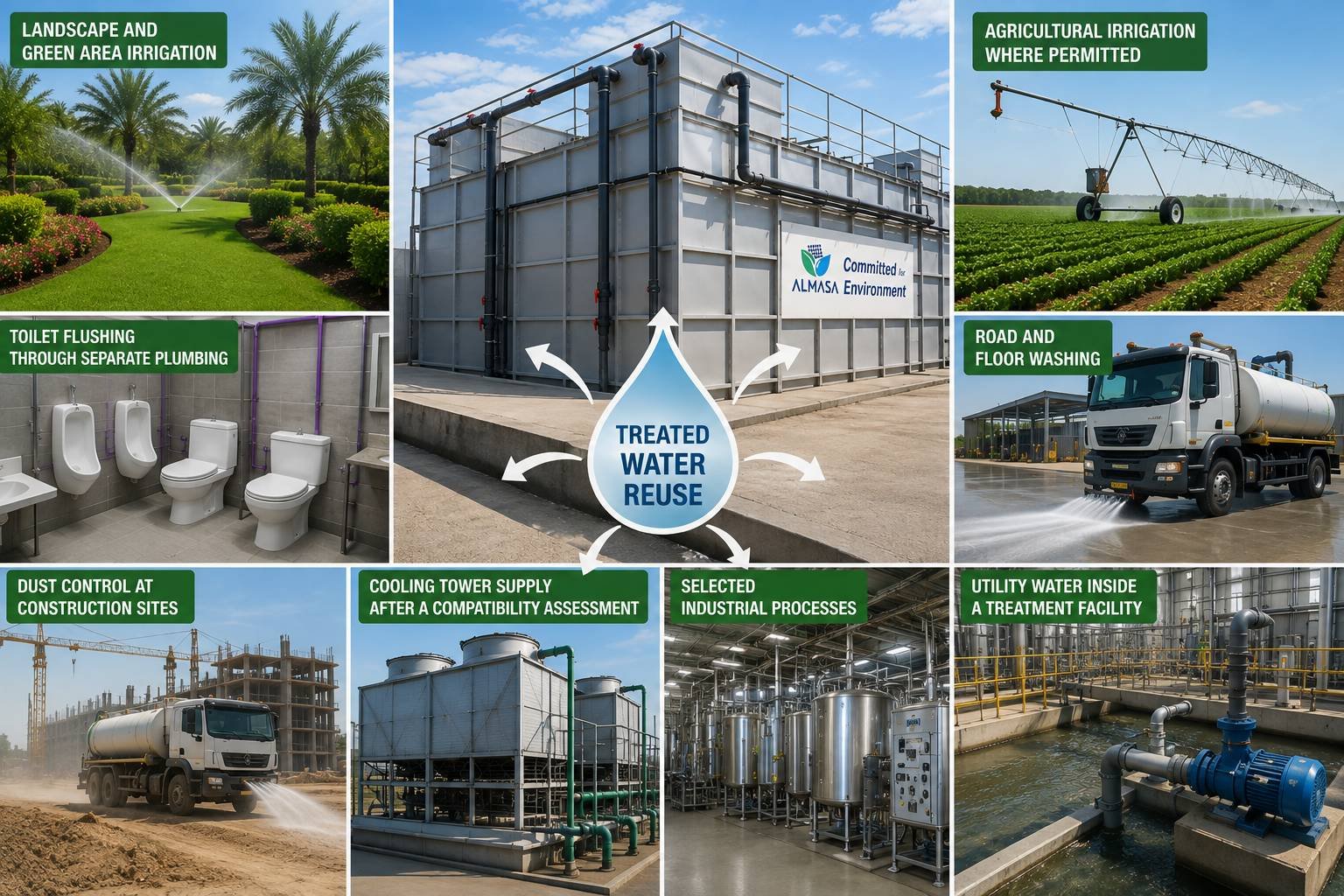
Treated wastewater can support several applications, subject to the required approvals and water quality standards.
Common applications include:
- Landscape and green area irrigation
- Agricultural irrigation where permitted
- Toilet flushing through separate plumbing
- Road and floor washing
- Dust control at construction sites
- Cooling tower supply after a compatibility assessment
- Selected industrial processes
- Utility water inside a treatment facility
Each application creates different technical requirements. Irrigation water may need controls for salinity, nutrients and microorganisms. Cooling tower water must be checked for hardness, silica, chloride and biological growth. Industrial reuse may require tighter limits based on the equipment or manufacturing process.
Treated Wastewater Reuse in Saudi Arabia: 8 Planning Decisions
1. Define the Reuse Demand
Calculate how much treated water the facility can actually use each day. Include seasonal changes, operating hours, required pressure and periods when demand may stop.
Landscape demand often rises during hot weather. A factory may need a stable supply throughout the year. If production and demand occur at different times, the project will need suitable storage or an alternative outlet for excess water.
2. Understand the Wastewater Source
Domestic sewage, greywater and industrial effluent should not be treated as identical water streams.
Testing should represent normal operation and peak conditions. Useful parameters may include flow, pH, BOD, COD, TSS, turbidity, salinity, nutrients and microbiological indicators. Industrial facilities should also test for contaminants related to their production process and cleaning chemicals.
3. Confirm the Required Water Quality
The intended application determines the treatment target.
Every treated wastewater reuse in Saudi Arabia project should be reviewed against the applicable environmental permit and authority requirements. The Saudi regulations for treated sewage water and its reuse provide an important regulatory reference during planning.
Approval should be based on verified laboratory results, not simply on whether the water looks clear.
4. Select the Correct Treatment Stages
A typical reuse system may include screening, biological treatment, solids separation, filtration and disinfection.
Additional treatment may be necessary where the wastewater contains excessive salinity, nutrients, colour, odour or industrial contaminants. The correct process should be selected after comparing the measured influent quality with the required final water quality.
Using a standard treatment package without this comparison can produce unreliable results and unnecessary operating costs.
5. Consider MBR Treatment
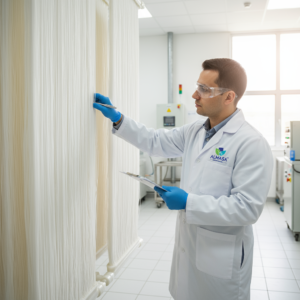
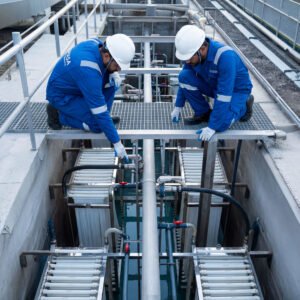
Membrane Bioreactor technology combines biological treatment with membrane separation. It can produce consistently low turbidity while requiring less space than many conventional clarification systems.
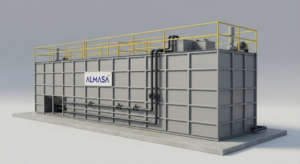
For treated wastewater reuse in Saudi Arabia, MBR can provide a strong barrier against suspended solids and support effective downstream disinfection. Almasa’s Monyin® MBR technology is designed for compact sewage, greywater and industrial treatment applications.
MBR does not normally remove dissolved salts. Additional treatment may be required when salinity or specific dissolved contaminants affect the intended reuse.
6. Design Reliable Disinfection
Disinfection may use ultraviolet treatment, chlorination or a combination of both.
Ultraviolet performance depends on treated water clarity, lamp condition and ultraviolet transmission. Chlorination depends on the applied dose, contact time, water demand and residual concentration.
The system should include monitoring, alarms and a defined response when the required disinfection condition is not achieved. Poor quality water should be diverted rather than allowed to enter the reuse network.
7. Plan Storage and Distribution
Storage tanks balance treated water production with daily demand. Poorly sized tanks can create overflow, stagnation, sediment accumulation or loss of disinfectant residual.
The design should consider tank turnover, mixing, covers, ventilation, overflow control, cleaning access and level monitoring.
Recycled water pipes must remain separate from potable water pipes. Clear identification, backflow protection, isolation valves and cross connection checks are essential before commissioning.
8. Establish a Monitoring Programme
A reuse system needs a clear testing and response plan.
Operators should know which parameters are monitored online, which samples require laboratory analysis and what action must follow an abnormal result.
Records should include the sampling location, date, operating condition, laboratory result and corrective action. Monitoring frequency should reflect the reuse application, treatment process and permit requirements.
Greywater Versus Treated Sewage
Greywater normally comes from showers, washbasins and similar sources that do not contain toilet waste. It may have a lower pollutant load than combined sewage, although detergents, organic matter and microorganisms still need treatment.
Sewage includes toilet wastewater and generally requires stronger biological treatment, solids separation and disinfection.
When planning treated wastewater reuse in Saudi Arabia, the choice between greywater and sewage depends on available flow, plumbing arrangements, reuse demand, installation space and lifecycle cost.
Facilities with suitable separate plumbing can explore Almasa’s greywater treatment systems. Projects recovering combined domestic wastewater can review Almasa’s sewage treatment plant solutions.
Water Quality Testing
Clear water is not necessarily safe or suitable for reuse. Testing must confirm that the complete treatment process is achieving the required result.
| Testing objective | Important parameters |
|---|---|
| Process performance | Flow, pH, dissolved oxygen, BOD and COD |
| Physical quality | TSS, turbidity, colour and odour |
| Health protection | Microbiological indicators and disinfection performance |
| Irrigation suitability | Salinity, nutrients and sodium related indicators |
| Industrial compatibility | Hardness, silica, chloride, alkalinity and conductivity |
Testing requirements should be agreed during design. Sampling points must be accessible, clearly identified and positioned where they provide useful information about process performance.
Financial and Sustainability Benefits
The financial case for treated wastewater reuse in Saudi Arabia depends on how much freshwater purchase and wastewater disposal the project can replace.
A proper lifecycle assessment should include treatment equipment, electricity, chemicals, laboratory testing, membrane or media replacement, sludge handling, operators, maintenance, storage and distribution.
A reuse system may offer limited value if there is no dependable demand for the recovered water. The reuse application and distribution network should therefore be planned before selecting the treatment equipment.
The Saudi Ministry of Environment, Water and Agriculture recognizes treated wastewater as an important nonconventional water resource and supports its use for suitable applications.
Common Planning Mistakes
Common mistakes include:
- Selecting equipment before defining the reuse application
- Assuming filtration alone makes water suitable for every use
- Ignoring salinity and industrial compatibility
- Installing oversized storage with poor water turnover
- Failing to separate potable and recycled water pipes
- Omitting alarms and failed quality diversion
- Forgetting distribution costs during budgeting
- Operating the system without trained personnel
Why Choose Almasa KSA?
For treated wastewater reuse in Saudi Arabia, Almasa KSA evaluates the wastewater source, treatment process, intended application and site conditions as one complete system.
The team provides sewage treatment, greywater recycling, industrial effluent treatment, Monyin® MBR technology, plant upgrades and ongoing maintenance. This integrated approach helps clients select practical treatment stages while planning for reliable operation and long term performance.
Questions to Answer Before Design
Before requesting a technical proposal, confirm:
- What is the average and peak wastewater flow?
- What does the laboratory analysis show?
- Where will the treated water be used?
- What daily and seasonal demand is expected?
- Which authority requirements apply?
- How much storage is required?
- How will recycled water remain separate from potable water?
- Who will operate and test the system?
- What happens when treated water quality is outside the required range?
- Is future expansion expected?