

STP Retrofit Assessment: 7 Essential Checks Before Reusing Existing Tanks
An STP retrofit assessment helps Saudi facility owners decide whether existing sewage treatment plant tanks and equipment can support a proposed upgrade. For an occupied compound, hotel or worker accommodation, retaining infrastructure is an attractive option. However, the decision needs evidence about condition, treatment duty and how the work will proceed while sewage continues arriving.
Before accepting a proposal built around your current tanks, ask for these seven checks. The objective is a documented decision about what can remain, what needs alteration and what should be replaced.
Quick answer: what should an STP retrofit assessment establish?
Existing tanks are candidates for reuse when their assessed condition, usable geometry and connections suit the proposed process. The assessment must also address equipment capacity, access and treatment continuity during construction. A tank’s nominal volume or an equipment layout alone cannot demonstrate that the upgraded plant will meet its required duty.
Seven checks for your STP retrofit assessment
1. Define the problem and the required outcome
Separate increased sewage flow from poor treatment performance or a changed effluent requirement. These problems may call for different interventions. Record current and expected occupancy, measured flows, influent and effluent results, and recurring operating problems.
The EPA manual on upgrading existing wastewater plants starts with an investigation of performance, operations, structures and equipment. Although this is historical technical guidance, its evidence-first approach remains useful; its old design values and costs should not be adopted for a current project.
For KSA, identify the actual discharge or reuse destination and relevant approval conditions. Check the applicable route with the responsible authority, including the NCEC water-discharge permit service where relevant. Do not assume the existing approval covers a changed duty.
2. Assess tank condition before committing to reuse
For concrete tanks, assemble drawings, repair history and available inspection records. Have a qualified structural specialist assess deterioration and determine whether further investigation or material testing is necessary.
The public preview of ACI 364.1R-19 on assessment before rehabilitation identifies document review, field investigation, sampling, testing and reporting as parts of the assessment. It is international guidance, not a substitute for applicable Saudi requirements.
In the STP retrofit assessment, request an explicit conclusion about suitability for the proposed use, required repairs and unresolved conditions. A photograph showing no obvious damage is not equivalent to that conclusion. Steel or composite tanks need assessment appropriate to their materials.
3. Verify usable geometry and the hydraulic route
Check measured internal dimensions against drawings, then identify operating water levels, partitions, inlets, outlets and connections between compartments. Ask the process designer to show which volume performs each treatment function.
Illustrative example: a rectangular compartment measuring 5 metres by 4 metres contains 60 cubic metres at a 3-metre water depth. At 2.5 metres, it contains 50 cubic metres, before allowing for internal displacement. Neither figure is a treatment-capacity rating.
Request a hydraulic profile covering the proposed flow conditions. It should make clear how water passes through retained and new components and which levels or connections need alteration.
4. Check whether the proposed process actually fits
Physical space for equipment is only one part of compatibility. Ask for the proposed process arrangement, biological design basis, aeration requirements and manufacturer-specific installation conditions.
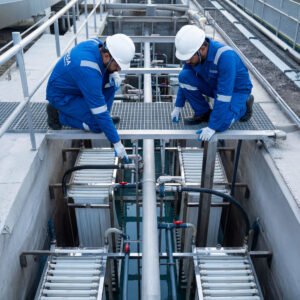
For a membrane bioreactor conversion, the EPA MBR fact sheet highlights screening, operating water levels, peak-flow limitations and oxygen-transfer considerations. These explain why installing membrane modules alone does not establish a complete retrofit design.
Your STP retrofit assessment should identify modifications outside the membrane compartment too. Obtain current documentation for the actual equipment proposed rather than applying generic screen sizes or operating limits from another installation.
5. Recheck equipment against its proposed duty
Create a retain, modify or replace schedule for pumps, blowers, screens, sludge equipment, instruments and controls. Support retention with condition evidence and a comparison between the existing equipment’s capability and the new duty.
Ask the designer to document operating points and available electrical capacity, rather than treating a running motor as proof of suitability. Include the parts and controls needed to integrate retained equipment.
This part of the STP retrofit assessment concerns engineering suitability. Routine servicing and replacement of worn parts belong in the maintenance scope, even when both activities occur during the same shutdown.
6. Confirm installation and future maintenance access
Ask how each major component will reach its final position and later be removed. Review access openings, lifting arrangements, working space, pipe routes and the location of new panels against the actual site.
For a hotel or residential compound, include delivery access and restrictions on disruptive work in the installation plan. Require suitable isolation and safe access procedures before intrusive inspections or tank work.
Record access constraints in the STP retrofit assessment before ordering equipment. An unresolved removal route can remain a maintenance problem long after construction finishes.
7. Plan treatment continuity and the final decision
Identify what happens to incoming sewage while each tank or treatment train is unavailable. Request a phased sequence, the capacity available at each stage and a contingency if work takes longer than expected. Temporary handling arrangements must follow the applicable approvals.
Agree how the upgraded system will be brought into service and how performance will be demonstrated. Summarise the assessment in a decision table:
| Decision | Evidence to record |
|---|---|
| Retain | Condition and suitability for the proposed duty |
| Modify | Defined repairs or alterations and verification required |
| Replace | Documented reason retention is unsuitable |
| Investigate further | Missing evidence, responsible person and decision deadline |
Arrange an STP retrofit assessment with Almasa
Almasa’s existing STP and ETP upgrade services include infrastructure evaluation and upgrade recommendations. Contact Almasa to discuss your existing STP, sharing drawings, operating records and the proposed change in duty. Ask for the assessment scope and any separate specialist investigations needed before finalising tank reuse.
What are the minimum ETP quotation requirements for a Saudi factory?
Provide your factory location, process description, flow estimates, available laboratory results, intended outlet and site layout. Identify missing information and ask the supplier to state assumptions before relying on the quotation.
Can I request an ETP quotation before production starts?
Yes, as a provisional estimate based on the planned process and a documented water balance. Confirm how actual wastewater testing and production changes could affect the final design and price.
Does one discharge standard apply to every Saudi ETP?
Do not assume so. Confirm the requirements for the facility, receiving network or discharge route, intended reuse and relevant authority. State the agreed targets in the enquiry and acceptance criteria.
Should ETP quotation requirements include operation and maintenance?
Yes. Specify whether operators, servicing, chemicals, spare parts, testing and sludge handling are included or separately priced. This helps compare total responsibilities across proposals.
Discuss your ETP quotation requirements with Almasa KSA
Almasa provides industrial effluent treatment solutions. Contact the KSA team with your factory location, flow records, laboratory reports, site layout and intended outlet to discuss a proposal. Identify any missing information so the technical review can address it.